
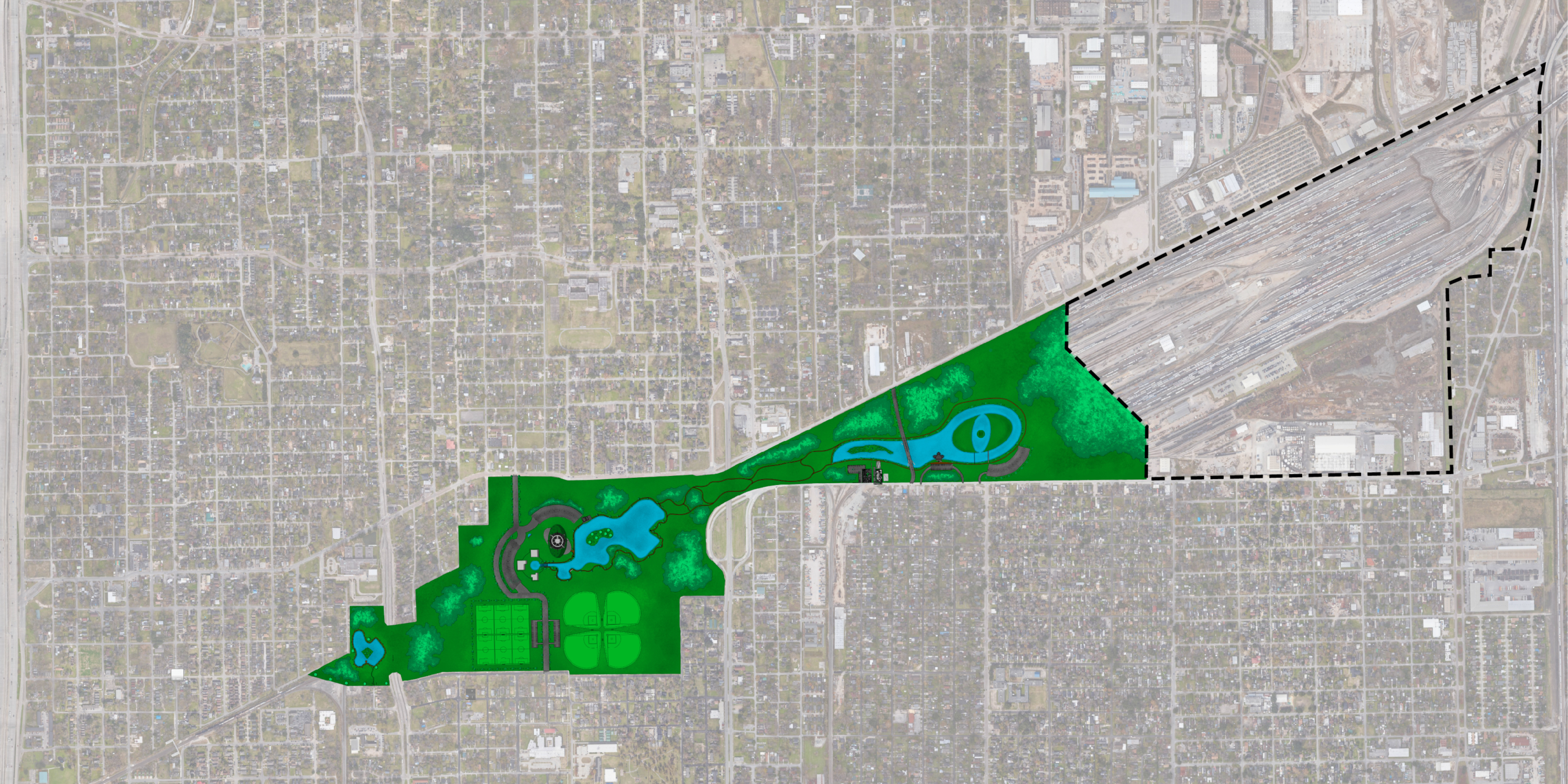
Switching Station City Park

In my first semester back to school after almost 15 years removed, my first project was supposed to be a economic home for a low income neighborhood. The class was all doing their own based on the lot they were assigned and we all were going to go about our ways. The thing with this, though, is that this was an undergraduate studio class and I was in the graduate degree plan. These studios were thrown into the degree to kind of get your creative juices flowing. Unfortunately, for the past couple of years I had been doing tiny homes and was kind of bored of them. I talked to my professor about it and her and I came up with idea to work on creating the park that would feed into the rest of the class’s project.
First, I went to see what the park property lines were going to be so I went to CADMapper to get a line drawing of the location. This would help determine where to start off.

Turned out, the location was going the be a reappropriated railway system which is currently a brownfield. The rehabilitation of the site was not in the scope so the logistics of that isn’t considered.

The starting point with the Switching Station City Park project was to determine what types of parks does the city of Houston actually use and exactly how big of a space was I dealing with. I’ve been to many parks throughout the world and they all offer something different. Naturally, I didn’t want to try to make a Japanese or English park and try to place it in Texas. I went around town, took pictures, looked at satellite photos, and finally took a scale of the main parks, as well as Prairie View A&M University, and plopped it into the line drawing provided by CADMapper and this was a lot bigger than I could have imagined.

The entirety of Houston’s Hermann Park, which houses reflecting pools, an amphitheater, sculpture garden, Japanese garden, and the zoo all fit inside the small portion on the Southwest corner of the site. Discovery Green, which was the location of the Super Bowl activities, the NASA Apollo 11 festivities, restaurants, etc. fits, and the entirety of the PVAMU campus fits. All total, the site comes up a little over 22.5 million square feet or 517 acres.
One of the things I had also been wanting to work on was a music venue of some kind. I loved going to venues and being amazed by all the work that is done to make the music sound amazing. I wanted to bring that outdoor life to this park since I feel it’s what makes Hermann Park an amazing experience as well.

Walking around other parks also gave me ideas with which I would later use as little monuments to be placed around the site. This would be scenic viewpoints, photograph locations, restaurants, amenities, and others.


After a couple of months of iterating the design, talking to other classmates at what they would like to see in the park, my teacher as what would be beneficial to the district, I began on working on many iterations. I would add, subtract, and massage things to make it all fit. With the amount of space I could put in everything which included:
- Amphitheater
- Restaurants
- Walking trails
- 5K running loop
- Shopping
- Upscale restaurant
- Outdoor movie theater
- Community Center
- Private park
- Bird Reserve
- Athletic facilities
I honestly could have kept adding more and more items but there is only so much time in a semester and, in the end, you do have to put pencils down.


Project Information:
School Project
Spring 2022
Tags: School Work